History of Bursa
The first capital of the Ottoman Empire, weaves centuries of history into its streets, mosques, and bazaars.
Bursa, nestled at the foot of Mount Uludağ in northwestern Turkey, is a city steeped in history. Its story begins long before it became the first major capital of the Ottoman Empire. The land around Bursa was once inhabited by various civilizations, including the Phrygians, Lydians, Romans, and Byzantines, all leaving traces of culture, trade, and architecture.
Kayi Tribe and the Foundations of an Empire
The story of Ottoman beginnings starts with the Kayı tribe, a branch of the Oghuz Turks, who migrated from Central Asia. Among them, Osman Gazi emerged as a visionary leader. According to legend, Osman had a dream of a tree whose roots spread across the lands he would conquer—interpreted as a divine sign that he would establish a vast empire. This dream guided his ambitions and shaped the foundation of the Ottoman state.
Osman’s early leadership was marked by skirmishes with neighboring Byzantine territories. His first major victory came with the capture of Karacahisar Castle, establishing the first foothold of his dominion.
The Six Ottoman Sultans of Bursa
Bursa, the first major capital of the Ottoman Empire, is the resting place for six early sultans. Their reigns shaped the empire’s foundation, setting the stage for centuries of growth. Each sultan left behind remarkable achievements and fascinating stories.
1. Osman Gazi (reigned 1299–1326)
- Significance: Founder of the Ottoman Empire.
- Achievements: United the Kayı tribe, fought Byzantines in Northwestern Anatolia, and laid the groundwork for the empire.
- Mini-story: Legend says Osman Gazi had a prophetic dream of a tree growing from his navel, spreading over vast lands. He interpreted this as divine approval that his dynasty would grow into a powerful empire. His burial in Bursa, in a modest tomb, reflected his humble yet visionary nature.
2. Orhan Gazi (reigned 1326–1362)
- Significance: Expanded the Ottoman state and captured Bursa.
- Achievements:
- Captured Bursa in 1326, making it the Ottoman capital.
- Established the first Ottoman administrative institutions, including the divan (council) and the treasury.
- Introduced the first Ottoman coins and formalized taxation.
- Built public works: baths, mosques, and hospitals, improving city life.
- Mini-story: Orhan married a Byzantine princess, Theodora, in a diplomatic alliance, blending cultures and securing peace. Under his guidance, Bursa became a hub of trade, attracting silk artisans who established the city’s famed silk bazaar.
- Nearby: Visit the Ulu Camii (Grand Mosque), built under his reign, symbolizing the city’s first major Islamic architecture and Bursa’s rise as a political hub.
3. Murad I (reigned 1362–1389)
- Significance: Expanded Ottoman control into the Balkans.
- Achievements:
- Introduced the Janissaries, an elite standing army recruited from Christian territories.
- Expanded Ottoman rule into Thrace, establishing footholds in Europe.
- Strengthened Bursa’s religious and educational institutions.
- Mini-story: Murad I was known for personally inspecting new recruits for the Janissaries. A popular story tells of him sparing a young boy for his intelligence, foreseeing his future as a great officer—a reflection of Murad’s strategic mind. He was ultimately killed in the Battle of Kosovo, a dramatic end that solidified his legend.
- Nearby: Explore the Green Mosque (Yeşil Camii), which reflects the flourishing arts during his reign.
4. Bayezid I (Yıldırım – the Thunderbolt, reigned 1389–1402)
- Significance: Rapid military expansion; consolidation of early empire.
- Achievements:
- Expanded Ottoman territory rapidly in both Anatolia and the Balkans.
- Fortified Bursa’s walls and commissioned significant architectural projects, including mosques, baths, and caravanserais.
- Developed a system of local governance to stabilize new territories.
- Mini-story: Bayezid earned his nickname “Yıldırım” (Thunderbolt) because of the speed and decisiveness of his campaigns. He was captured by Timur at the Battle of Ankara, a shocking defeat that temporarily fractured the empire. According to some accounts, Bayezid’s imprisonment was marked by defiance and calm, showing his legendary stoicism.
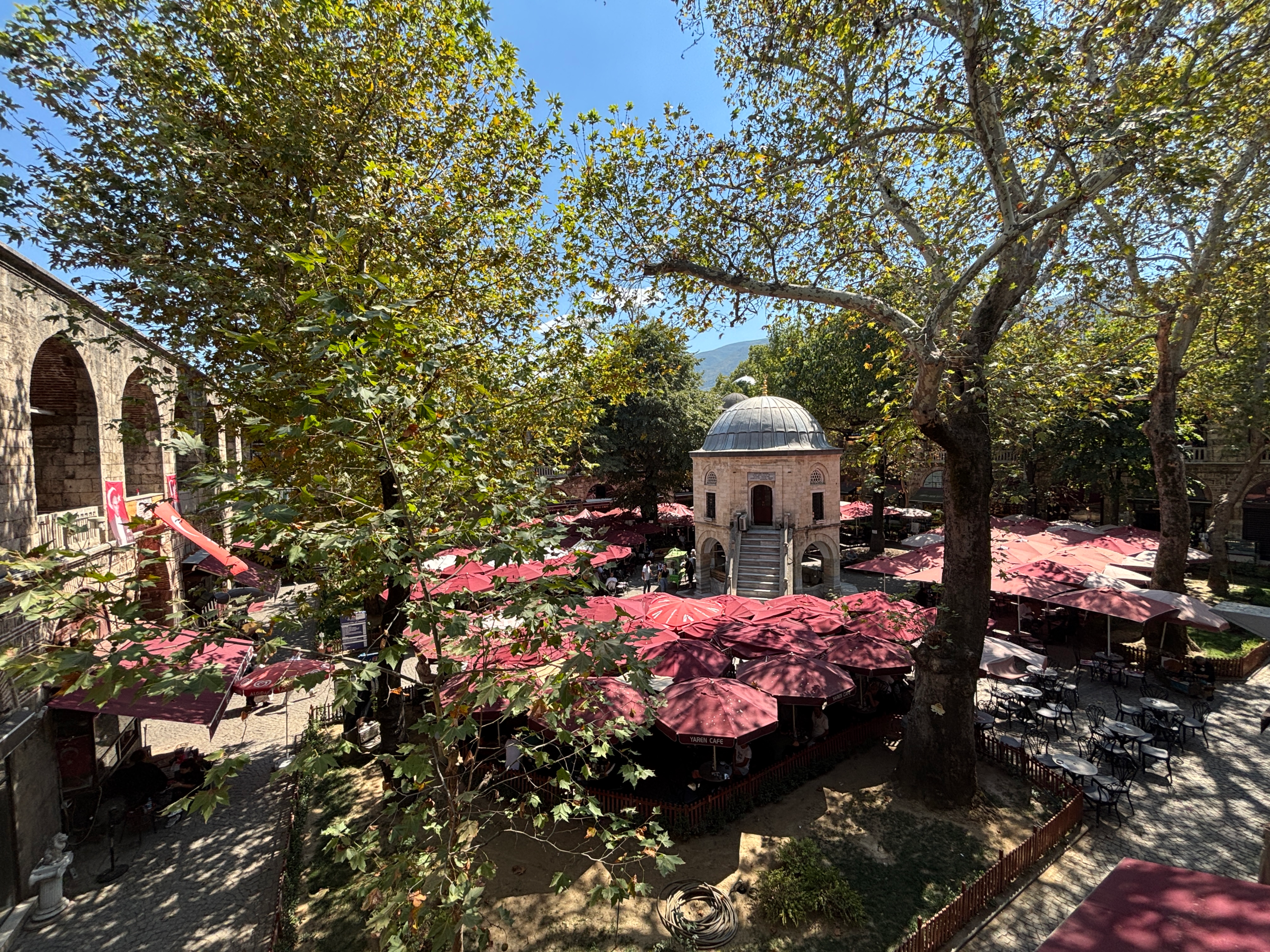
- Nearby: Visit the Koza Han, the historic silk bazaar that thrived under Bayezid’s rule, reflecting the city’s commercial boom.
5. Mehmed I (reigned 1413–1421)
- Significance: Reunified the Ottoman Empire after the Interregnum (civil war following Bayezid I’s capture).
- Achievements:
- Restored central authority and stability after the chaos caused by Bayezid’s defeat.
- Rebuilt Bursa’s economy and public works, reestablishing it as a political and cultural center.
- Mini-story: After years of civil war among Bayezid’s sons, Mehmed I emerged victorious. A notable anecdote tells of him holding a council with all rival claimants, showing both diplomacy and resolve in asserting his authority without massive bloodshed.
- Nearby: Explore the Green Mosque (Yeşil Camii), which reflects the flourishing arts during his reign.
6. Murad II (reigned 1421–1451)
- Significance: Strengthened the Ottoman state internally and militarily.
- Achievements:
- Consolidated Ottoman power in Anatolia and Europe.
- Modernized the army and expanded naval capabilities.
- Commissioned many religious, educational, and social works in Bursa and elsewhere.
- Mini-story: Murad II faced multiple rebellions early in his reign but famously quelled them by combining military strength with strategic diplomacy. One story recounts how he personally visited a rebellious town, negotiating peace and showing magnanimity to avoid further bloodshed—a trait that earned him both respect and loyalty.